Boggle-style strategy: find more words, one pattern at a time.
Use this teaching board to practice short words, extensions and turning paths. Then try the same habits in a timed round.
Start with a board you can inspect.
Connect neighboring letters horizontally, vertically or diagonally. You may change direction. Do not use a tile twice in one word. The illustration traces STONES; the same board also contains shorter words you can find without following that path.
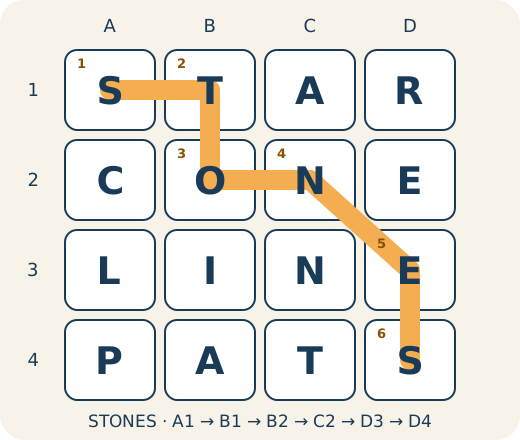
Before opening the answers, find STAR, CONE, LINE, TONE and STONES. You can repeat a tile in a different word, just not within one word.
Show the five paths
- STAR: A1 → B1 → C1 → D1.
- CONE: A2 → B2 → C2 → D2.
- LINE: A3 → B3 → C3 → D3.
- TONE: B1 → B2 → C2 → D2.
- STONES: A1 → B1 → B2 → C2 → D3 → D4.
These are ordinary English examples with valid connected paths. Games use different dictionaries and word rules, so check the particular game rather than assuming every word list is identical.
Scan a small area, then move on.
Start at one corner and inspect its neighboring letters. When that area stops producing words, move to the next starting tile instead of looking at the entire board again. A simple left-to-right pass can help you remember which areas you have already explored.
On this board, the top row gives STAR. Moving down one row gives CONE. Then inspect paths that turn: TONE begins in the top row but drops down before continuing right. Straight lines are a useful start, not a restriction.
Try this as a practice method, not a rule you must follow during every match. If a longer word jumps out, take it.
Look around the end of a word.
After finding STONE along A1 → B1 → B2 → C2 → D3, inspect the tiles touching its final E. The S directly below it makes STONES. You have found a second word by extending a path you already know.
An extension only works when the extra letters are adjacent and unused in that path. Seeing an S somewhere on the board is not enough. The same applies to endings such as -ED or -ING: each required letter must be reachable in sequence, and the resulting word must be allowed.
Also try a shorter version when it is a real word. STONE and STONES are separate entries; repeatedly submitting the same word does not create another discovery.
Choose the practice before starting the clock.
Use a longer Solo timer when learning to trace turning paths. Use a shorter timer when practicing quick recognition. In GridzyPals, configurable Solo rounds run from 30 seconds to 3 minutes across 4×4, 5×5 and 6×6 boards.
During a timed round, move on if a promising start stops producing a valid word. You can inspect it again afterward. Spending the entire round chasing one uncertain long word leaves less time for words you already recognize.
Try one change at a time and see whether it helps your own play.
Learn one missed word after each round.
Pick one missed word from the results and retrace its path. Was the hard part noticing the starting letter, turning diagonally or recognizing an ending? Name that one pattern before starting another round.
Keep board size and timer the same when comparing your practice sessions, while remembering that different letter layouts can still change the difficulty. A raw score on a larger grid or a longer timer is not a like-for-like comparison.
Daily is a separate shared challenge. Its settings are fixed for comparison, and it uses a free account. See how Daily rankings and history work.
Know which rules your round uses.
GridzyPals awards more points for longer words. VS and live rooms using double-points scoring reward words only one player found; shared words still earn their regular points. Check the room rules before applying a strategy built around unique words.
Do not carry assumptions about shared words, hints, minimum lengths or bonuses from one Boggle edition to another. Read GridzyPals rules and compare the cited tabletop edition when switching formats.
We make GridzyPals. The teaching board is an original practice exercise. Boggle is a trademark of Hasbro; GridzyPals is not affiliated with or endorsed by Hasbro.
Try a Solo round.
Choose a board and timer, then review one word you missed.
Browser guest Solo is free. Internet required. Daily, multiplayer and saved progress require a free account. Optional purchases.